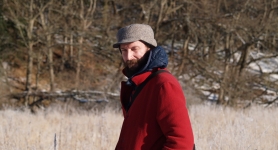
Pat Kane, author of the play ethic, doesn’t think that modern life and technology has to make us unhappy. Choice and complexity and diversity should be a good thing. But he does think we should be working less – he’d like to see a 35 hour working week (like France used to have) and that the state should fund us to do a lot of cool stuff when we’re not working.
http://www.flickr.com/photos/kikisdad/ / CC BY 2.0
Work itself should unleash the kind of creative energy that we have when we play.
“we are our own gods, and might as well get good at it…”
Pat, out of everyone I have spoken too, is the least reserved about the benefits of the information society. Rather than drowning in the information deluge, he’s thinks we should grow gills and swim.
Community
Alan Caldwell is a board member for the Comrie Development Trust, and a community development trust consultant himself. Comrie has one of the most active local communities in the UK – with a population of only 2,000, 700 people are members of the development trust, and it has 56 local groups.
Alan Caldwell's Community Words...courtesy of www.wordle.net
Try a bit of word association – just sit down and type. Stream of consciousness stuff.
I did. These are the results for ageing and food.
Right, now it’s your turn. Try happiness. Or community. Send the results back to me, and I’ll put them together and make more word clouds.
Er, why?
It’s part of a new series on BBC Radio Scotland called Radical Thinking. Were going to be looking at five modern preoccupations in a free-form way.
Happiness, Food, Aging, Poverty and Community.
In each show, Edi Stark will meet up with two people with unconventional ideas, and together, they’ll push them even further – to envisage radical solutions for the future of Scotland.
Let us know your ideas, and we’ll include them in the mix!
The leader of Edinburgh city council, Jenny Dawe, has unexpectedly announced that they will not be proceeding with the tenders for social care and support services.
The new contracts would have affected around six hundred people with physical and mental disabilities, transferring them to private care businesses. The changes were being resisted by a broad coalition of voluntary groups, care workers, and disabled people themselves.
A special meeting of the finance and resources committee was meant to make a decision on the controversial issue tomorrow morning, and most of the Edinburgh care groups affected had expected the tender to be pushed through.
But, apparently reacting to the depth of feeling surrounding the tendering exercise, Councillor Dawe has suspended the process until January, so that an independent investigation can be completed.
In a letter, she said “I recognise the importance of the Care and Support Services Tender to vulnerable people in the city and have insisted that all aspects of the tendering process must be robust.
I have been in regular touch with senior council officials on this and have just been advised that there remain a number of outstanding issues surrounding the Care and Support Services Tender.
As a result, I have instructed the Chief Executive to have the tenders independently evaluated.”
The outcome of the dispute remains uncertain. Health and Social Care Convenor Paul Edie had argued that any delay past the 5th of December could result in legal action against the council by the companies which had won the tender.
Whether or not this threat remains, and whether the council is still committed to the tendering process, remains to be seen.
Is this the most colourful woman in Edinburgh? Margaret Anderson has an unrivaled passion for dance – salsa, tango, pole dancing, belly dancing, and even African welly dancing. Don’t know what that is?
Check out my interview with her, and tune in to the uncut, raunchy version on the Radio Cafe, Tuesday 1st December, 1:15 – part of 45 minutes of flamboyant dance action.
Over three weeks ago, people from around the world began a hunger strike in the run-up to the Copenhagen climate conference.
They want world leaders to commit to a substantial, legally binding agreement at the conference – something that looks increasingly unlikely.
At 61 years old, Michael is the eldest of the climate justice fasters. Because of that, he also faces the greatest risks to his health – including organ failure and brain damage. A few days ago he made this eloquent video.
Last thursday, the SLD-SNP administration that runs Edinburgh city council lost its first ever vote.
The issue?
Whether or not to use competitive tendering for care services for disabled and mentally ill people in the city.
What many thought would be a rubber stamp for new contracts and new private companies instead became a dramatic victory for grassroots democracy and local community groups.
http://www.flickr.com/photos/lollyknit/ / CC BY-NC 2.0
Care groups like Garvald are woven into the fabric of the local community.
When I interviewed Councillor Edie the next day, he was bullish about the defeat.
He said that the tendering process was still necessary. He spoke about the wide disparities between the rates charged by some voluntary care providers and others – between £11 and £32 per hour.
His strongest argument was that the money saved (£1.8 million a year) could be put towards disabled people who currently have no provision in the city. And he said that if these savings weren’t made then there would have to be substantial cuts in care provision.
But when I asked him why he had so spectacularly failed to communicate this to the care groups during the council meeting, he said that he was trying to persuade his fellow councillors – not the audience in the gallery.
And it’s that failure to communicate – and above all to listen – that has got the council into this mess in the first place.
http://www.flickr.com/photos/slipstreamblue/ / CC BY-NC-ND 2.0
My latest piece for FSRN. Broadcast 20 November 2009.
The UK Government has unveiled it’s new Digital Economy Bill. The headline grabbing plans are a tax on landline phones to fund super-fast broadband in rural areas of the UK, and a crackdown on illegal internet file-sharing and downloads.
Like France, which has created a “three strikes and you’re out” law, the bill includes powers to cancel people’s internet supply if they won’t stop.
But will it work?
Tom Allan’s been looking for perpetrators on the streets of Edinburgh…
Today was meant to be the day that the council ratified controversial reforms to social care services for disabled and mentally ill people. The plans would have saved the council some £5.4 million over the next three years. But they would also have meant enormous upheaval.
Most of the city’s existing service providers, including voluntary organizations and charities with decades of experience in the capital, lost out when the contracts with the council were re-tendered. Most of the new organizations coming in have no previous record of working with people in the city.
In the ornate and formal surroundings of the council chamber, a stream of people stood up to give evidence of the impact the changes would have. Carers, parents, and people with learning difficulties spoke passionately about their lives. They spoke of the close relationships they’ve built up with carers, and how important those relationships are to their health and stability.
It was inspiring to see people who have to deal with profound disabilities coming to the city chambers and getting involved as active citizens in the democratic process. Sometimes their speeches were angry, swearing with frustration. But they proved persuasive.
People like Maggie, who has bi-polar disorder, asked Councillors to vote with their hearts.
So many people turned up to the meeting that the public gallery was soon packed, and a spill-over room was quickly filled too.
In the late afternoon, with the testimonies over, the main debate began.
Councillors Paul Edie and Jenny Dawe, Leader of the Council, tried to convince fellow councillors (and the angry crowd in the public gallery) that tenders were a necessary measure, and that organizations had been selected principally on their quality – not their cost.
Mrs.Dawe explained that the two factors had been considered by separate and independent groups, and that the tenders were decided on a rigorous 70% quality, 30% cost basis. She said that many carers would be able to transfer to the new companies, and stay with their clients.
But service providers and users were unconvinced. Ian Wood of Disability Alliance Scotland said that disabled clients were already voting with their feet, with hundreds of them applying for direct payments. That way, they could continue to employ the carers and organizations that they know and trust.
Other people expressed their disbelief that the council could claim that the quality of the services would go up, even as the cost was cut by 21%.
In the end, it came down to a dramatic roll-call vote.
In the last year the Edinburgh City Council has put out for tender the contracts for the provision of its care and support services.
The aim, according to Paul Edie, convenor for health, social care and housing, is to “increase capacity, improve care quality and decrease costs.” In fact, they hope to save as much as £5.5 million over the next three years.
www.flickr.com/photos/dalonian/ / CC BY-NC-ND 2.0
What price will service users pay for the council’s cost cutting measures?
Tomorrow the council meet in the city chambers to ratify their decision about who should receive the contracts. This decision criteria for the acceptance of tenders was announced as 70% quality and 30% cost.
But as a service user, my fear is that this process is only a cost cutting exercise. And it seems clear that the best service providers, with years of specialist experience of working with people with disabilities, will be the ones to go.
The annual general meeting of the Edinburgh Student Union Association was nothing if not ambitious. On the cards was a boycott against Israel, a ban on the sale of cigarettes on the campus, and a ban on the BNP. On a more positive note, there was a motion to make the University more energy efficient (but I guess you could see that as a ban on carbon…)
As if that wasn’t radical enough, it seems that the whole event was a live twittathon, as dozens of students used the social networking site twitter to let the world (and me) see what was going on. There was even a giant twitter screen in the hall!
The gap in life expectancy between the sexes is closing because men are beginning to lead healthier lifestyles than women, Scotland's top doctor has said.
This week we held our festive gathering. We had a couple of speakers, including Rosie Lewis, from Changeworks, who ran an interesting workshop to introduce the Kitchen Canny project - a project that aims to help people cut their food waste. Rosie was full of facts and certainly gave us food for thought...Did you know how much beer Scottish people throw away […]
Bolivian President Evo Morales recently arrived in Copenhagen for the UN Climate Summit. In a press conference Wednesday, Morales said, "The budget for the United States is $687 billion for defense and they want for climate change - to save life, to save humanity - they only put up $10 billion. This is shameful."
After Hurricane Katrina the Center commissioned seven seasoned reporters to probe the government’s overall unpreparedness for natural or man-made crises, and their reports became a well-reviewed book.
Author: admin Subject: THE SILENCE OF THE BBC 100 - BBC TRUST CHAIRMAN RESPONDS TO Posted: Mon Dec 07, 2009 11:05 am (GMT 0) Topic Replies: 0 THE SILENCE OF THE BBC 100 - BBC TRUST CHAIRMAN RESPONDS TO 'NEWSPEAK' One of our readers recently took us to task for a serious omission in our new book, 'Newspeak in the 21st Century' (Pluto Press […]
For the past five months or so, we’ve been tracking the fascinating fundraising ups and downs of those fiscally conservative House Democrats, the so-called Blue Dogs. So as the year closes out, we’re here with a special holiday gift: the Dogs’ fundraising numbers for both October and November, which have finally snapped the downward trend t […]